

Photo Essays
4 MIN READ

These women spend all day carrying and transporting bricks. They represent the changing face of the construction industry in Nepal.
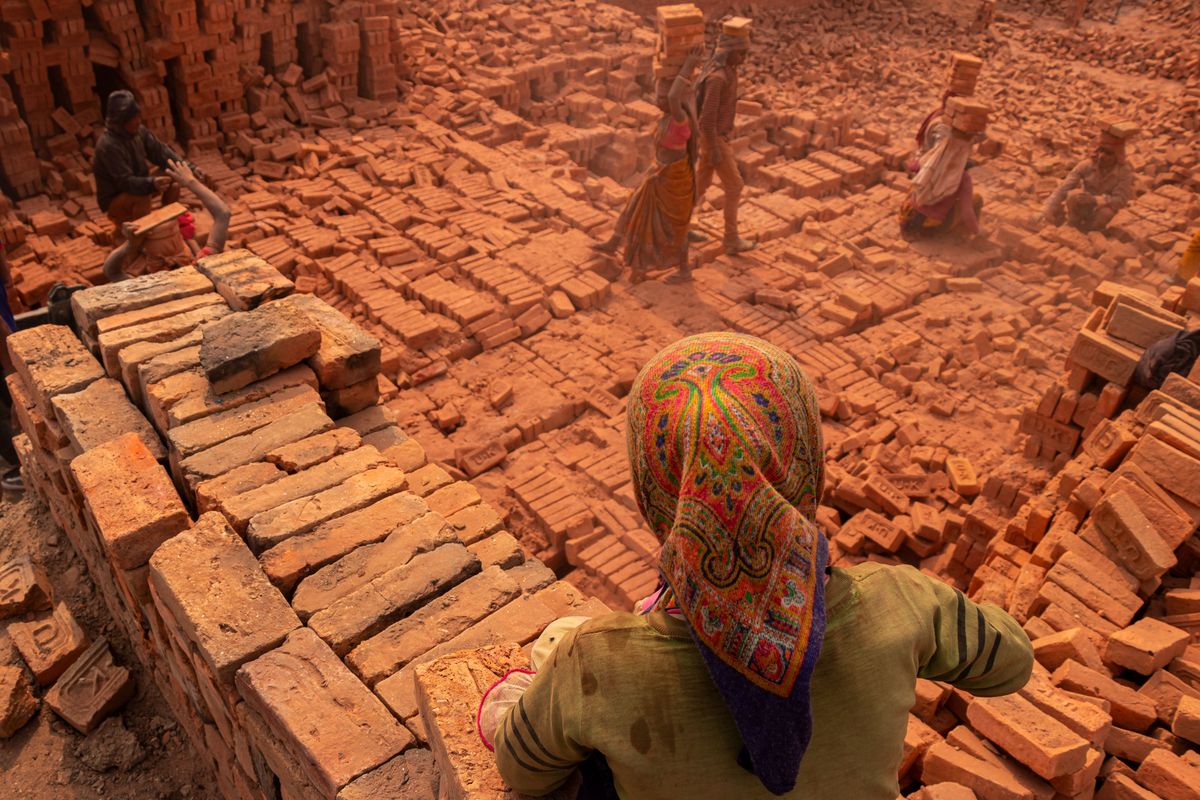
About 300 people work at the Bungmati Intertile Factory, stacking bricks on to their backs and transporting them either to storage or onto the backs of trucks. Out of the 300 workers at the factory, the majority are women who’ve come to the Kathmandu Valley from other parts of the country in search of work. Every year, as more and more Nepali men leave the country for work abroad, more women join the construction industry, which is in constant need of daily wage workers willing to do hard physical labor for not much pay.
According to the Nepal Labour Force Survey 2017-18, there were 111,000 women employed by the construction industry, compared to 867,000 men. But the majority of these women work under less than ideal conditions, according to a two-year research project, ‘Precarity, Migration and Agency: Women Construction Workers in Nepal’ conducted by the University of London’s School of Oriental and African Studies (SOAS). Most do not have proper work contracts and safety regulations are widely ignored.
I stopped by the factory on Sunday to speak to some of the women and try and understand their experiences working in an industry that is still largely dominated by men. Most of the women I spoke to lived on the premises of the factory and many of their husbands do the same work. The women work about eight to nine hours a day and are able to make between Rs 600-800, depending on the number of trips they make transporting the bricks.
During the Covid-19 lockdown in 2020, the brick factory had closed, forcing many of these women to go back to their hometowns. But now that the lockdown has been lifted and factories have opened up, the women are back at work.
Dipsara BK is 65 and has been working at this brick factory for six year. She came to Kathmandu from Rolpa in search of work and has been working in the construction sector ever since. The only time she went back home was during the Covid-19 lockdown in 2020.
“This work is tough but the more you work, the better you get paid,” she said.
Forty-seven-year-old Rima Pariyar’s world revolves around the premises of the factory. She, along with her husband, has been working in the factory for almost a decade now. They live together in a small hut on the premises of the factory, provided by their employers.
“I did not have any hope that I would be able to do this job. I was not fit at all, it looked like a manly job to me as it requires a lot of physical labor,” Pariyar told me, pulling down her face mask.
Like Rima Pariyar, Bisne BK too lives and works with her husband in the brick factory. They’ve been working at the factory for a year, having moved here from another factory. During the lockdown, she went back to her home district of Rukum, where she worked on a farm. But now, she’s back to transporting bricks.
“I work for at least eight to nine hours a day, which is hard for me but there is no other option as I am not qualified for any other job,” said Bisne.
Balkumari BK is 54 years old and from Rolpa. Her husband died some time ago due to an illness and she has been working ever since to provide for her three sons. Balkumari has been working at the Bungmati factory for six months.
:::::::::

Deewash Shrestha Deewash Shrestha is a student of Media Studies and a freelancer He can be reached via email: [email protected]


COVID19
Opinions
3 min read
Ordinances may have been scrapped but Oli’s credibility as the nation’s leader has reached a point of no return

COVID19
News
6 min read
With the govt unable to implement a coherent Covid strategy--including regarding festivals--fed up Lalitpur denizens take matters into their own hands

COVID19
Features
5 min read
Here’s a compilation of 10 of the many stories we at The Record published during the past year, especially during the four-month-long lockdown.

Perspectives
12 min read
Increasingly, non-Dalits are not just perpetrating violence against Dalits but protecting themselves from subsequent punishment by filing false counter charges against the victims

Interviews
6 min read
Public health expert Sushil Koirala discusses concerns around Nepal’s plans for mass quarantining migrants
COVID19
Explainers
5 min read
Already marginalised by the state, the Dolpo people are more vulnerable to the effects of the coronavirus pandemic

Explainers
21 min read
We have not dealt with a disease like COVID-19 in over 100 years.

Recommended
Perspectives
7 min read
Rupa Sunar’s act of resistance not only sparked the predictable rage of Bahuns and Chhetris but also unmasked many Janajatis who see themselves as crusaders of justice for the marginalized.


