

Features
4 MIN READ

In the middle of Nijgadh forest is a fertile 1,000 hectare plain where approximately 7,000 people live. Most of the residents of Tangia Basti are Tamangs, but there are also Magars, Dalits, Bramhins, and Chettris.

In the middle of Nijgadh forest is a fertile 1,000 hectare plain where approximately 7,000 people live. Most of the residents of Tangia Basti are Tamangs, but there are also Magars, Dalits, Bramhins, and Chettris. All moved here as part of a government tree planting project in the 1970s. Each family was offered 1 hectare of land, which they have been cultivating for decades. But they were never given official deeds to their land. All residents of Tangia Basti have heard about the Nijgadh International Airport. In the concept sketch that adorns a signboard at the entrance to Nijgadh, some 7-8 kms away, the Basti has been replaced by a runway.
The concept note currently being presented in lieu of a detailed project report proposes displacing Tangia Basti residents and constructing the airport’s first runway there. But no one has actually spoken to the people of Tangia Basti directly about any of this. They feel their fate hangs in the balance, but the uncertainty and lack of knowledge is even worse,
will the airport be built?
If so, how long will it take?
Will they get jobs?
When, and where if at all will they be resettled?
They have been asking for the last 30 years. Despite this, it is not the fact of the airport that bothers the Basti’s residents. They have heard rumors that the airport will bring the area development, generate employment, and change their lives for the better. The Basti is completely cut off from the national electricity grid, and there is no telephone service. Residents have installed hand pump sets for water and solar panels for electricity in their homes.
Parents collectively pay to hire teachers for a primary school and another school that goes up to standard 8. Students who go to Nijgadh for secondary school have to pass through sal and teak forests, where elephants and tigers lurk. The Record talked to the people of Tangia Basti about life in the settlement, and what they think of the Nijgadh Airport. [caption id="attachment_19314" align="alignnone" width="2000"] Bikki Pulami, 30, runs a restaurant in the Basti with his wife Binita Pulami Magar. He has been hearing about the airport for as long as he can remember. “We are not against development,” he tells us. He thinks an airport would provide employment for people in the Basti. But he has almost given up on the project: “They have been telling us that it will be built for so many years, I don’t believe it anymore.” Pulami is a former Maoist soldier.[/caption]
  [caption id="attachment_19320" align="alignnone" width="2000"]
 About two months ago, a load of wire and construction materials was brought into the village, some residents say by government employees, who then hired laborers to start fencing the Basti. Residents do not know why this is being done.[/caption] [caption id="attachment_19316" align="alignnone" width="2000"]
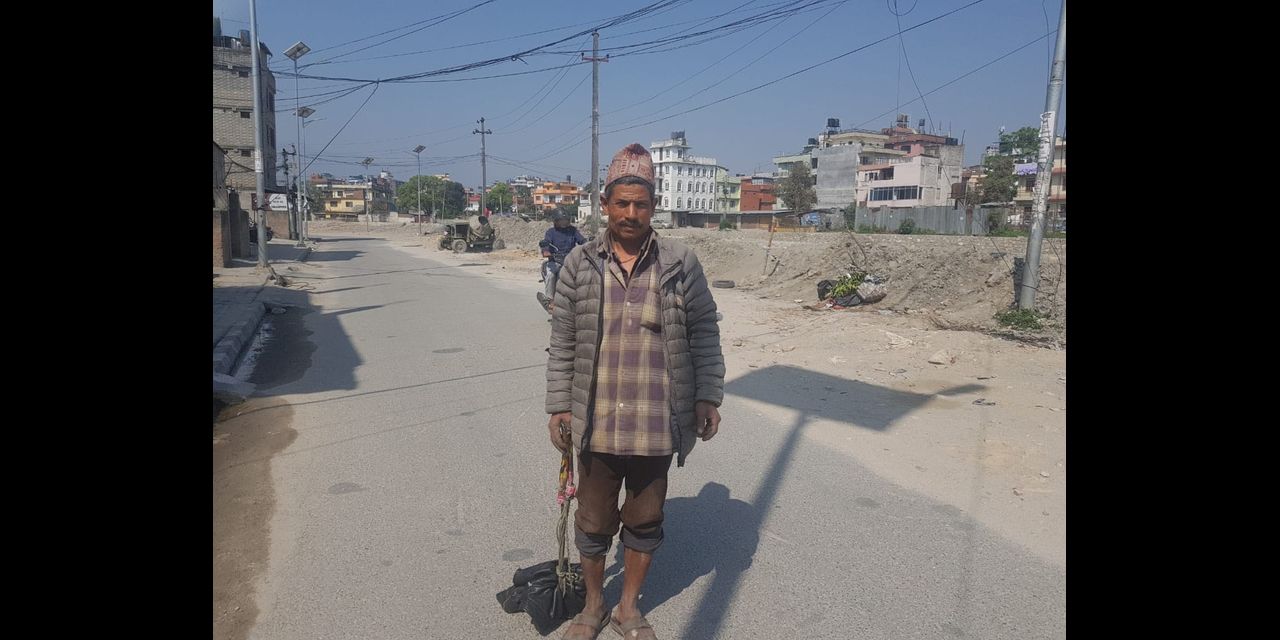
 Rabin Rai, 34, is a daily wage laborer working on the fencing. “We don't know what the purpose of this fencing really is. It cannot be for an airport, we know what an airport looks like. You don’t get an airport just by putting up fencing. If they are really serious about building the airport they should resettle us first,” he says.[/caption] [caption id="" align="aligncenter" width="2000"]
 Since residents of the Basti don’t know how long they will be living here, they are hesitant to do major repair work on their homes— a challenge, especially in the monsoon. Here, two men place a tin plate on the roof to temporarily abate the monsoon leaking.[/caption] [caption id="" align="alignnone" width="1333"]
 The civil aviation authority’s Environmental Impact Assessment about the proposed airport says that 2.4 million trees need to be felled.[/caption] [caption id="" align="alignnone" width="2000"]
 We were told that the tower in the village is for wifi. There is no proper mobile network here. Residents of the Basti can not even call an ambulance in case of an emergency. The district health centre, which is in the Basti, cannot handle cases involving severe injury or illness.[/caption] [caption id="attachment_19322" align="alignnone" width="2000"]
 Deepak Lama, 21, recently completed his bachelors degree and now wants to go abroad, preferably to Malta. “There is no future in this village, I want to go abroad and make money.” He didn’t tell us why Malta was appealing. Plastered around the village was a poster exhorting people to “learn Korean language and earn two lakh rupees per month.”[/caption] [caption id="attachment_19323" align="alignnone" width="2000"]
 Jiri Maya Theen, in her 40s, weaves carpet from her home. She wants to expand her business but has no collateral, since she has no proper papers for her land. She worked in Lebanon as a housemaid for two years. The difficulties she faced there convinced her to return home to make a living. “They have been saying that we will be evicted any day, but we have not been told anything about where and how we will be resettled. The government should give us land with proper papers somewhere in Bara district or provide compensation and guarantee one job per family, depending on our qualifications.”[/caption] [caption id="attachment_19324" align="alignnone" width="2000"]
 Dil Kumari Paudel, 70, did not want to discuss the airport, frustrated by how much it is talked about.[/caption] [caption id="attachment_19325" align="alignnone" width="2000"]
 Saru Tamang recently completed 12th standard and is teaching at a local primary school.[/caption] [caption id="attachment_19326" align="alignnone" width="2000"]
 Anita Moktan, 20 never went to school, and Sarita Moktan, 14, dropped out after 7th grade.[/caption] [caption id="attachment_19328" align="alignnone" width="2000"]
 A woman carrying fodder from the surrounding forest for livestock. Residents of Tangia Basti are heavily reliant on the forest for their livelihoods.[/caption]
:::
We welcome your comments at letters@recordnepal.com


Perspectives
Opinions
7 min read
On the eve of his arrest, Anand Teltumbde speaks to his people
COVID19
4 min read
Despite the government’s relief package, the poor and out-of-job in Kathmandu are not consoled

Culture
2 min read
Tourism entrepreneurs treat the country’s reopening for tourists with measured optimism

Features
5 min read
A look into the psychedelic culture's white-man problem.

Week in Politics
5 min read
Week in politics: what happened, what does it mean, why does it matter?

COVID19
Explainers
4 min read
The ban on yarsa harvesting, implemented to contain Covid19 spread, has upended Dolpa’s economy

Perspectives
7 min read
Tim Gurung reflects on his time as a businessman in Hong Kong and China and how the world of business taught him lessons about how the world works.

Features
30 min read
Two brothers are combining palliative care expertise, linguistics and AI to encourage more effective conversations between doctors and people receiving end-of-life care.

