

Interviews
6 MIN READ

Public health expert Sushil Koirala discusses concerns around Nepal’s plans for mass quarantining migrants

Over 100,000 Nepalis were expatriated from India to Nepal this past week, and the influx continues. As Nepal considers easing a nationwide lockdown, imposed to respond to the Covid19 pandemic, 400,000 migrants are expected to return, with 100,000 making their way back as early as this coming week. In what can be considered a major policy shift on pandemic management, Nepal’s Ministry of Health and Population (MoHP) announced on Saturday that it is inevitable some returnees will have to isolate at home and will not be mandated to undergo mass quarantine. Journalist Mallika Aryal talked to public health expert Sushil Koirala on why this move by the government may save more lives. Koirala has over a decade of experience of working in the public health sector across East and South Asia. In the past, Koirala had played a key role in the health reforms as a technical advisory to the health minister in Nepal.
It has to do with human instinct. If you look at some of the recent outbreaks such as Ebola and Zika, mobility was one of the major risk factors. When it comes to this pandemic, we also learned early on that restricting mobility was an important step in breaking the transmission. Holding potentially infected people, in one place, for some time, was a global strategy early on. Quarantine works when you take strict, solid measures. However, in Nepal, we lack the infrastructure, human resource and finances to make quarantine centers that are infection-safe and reliable. Nepal cannot expect municipalities and wards to make infection-proof mass-quarantine centers. If mass quarantine cannot be done safely, it becomes more dangerous. Two months down the line, we now have enough evidence that shows that mass quarantine camps are becoming incubation centers in Nepal. While they may delay community transmission, confined spaces like mass quarantine centers may increase the risk significantly.
It is now clear that mass quarantine systems along the India-Nepal border have broken down. The state must look after its citizens. It is not too late for those arriving via air as infection can still be safely managed as they arrive. We need to start screening as soon as they land. If we can collect swab specimens upon arrival by creating sample collection booths at the airport, it would be easy to detect cases as soon as they arrive. The risk of transmission at transit and transportation can be minimized by fever screening, mandatory masks, hand-hygiene and seat spacing. The hope is that they don’t have to be in quarantine for many days and most of them can safely quarantine at home. That’s why we must then take the four-tier, triage approach and make mass quarantine available to only those who can’t safely quarantine at home.
If you look at the evidence from the Diamond Princess Cruise and the American aircraft carrier Theodore Roosevelt, the attack rates in these confined spaces is almost six times higher than in the community. These were early evidence that mass quarantining for the infection that is this contagious was going to be extremely difficult.
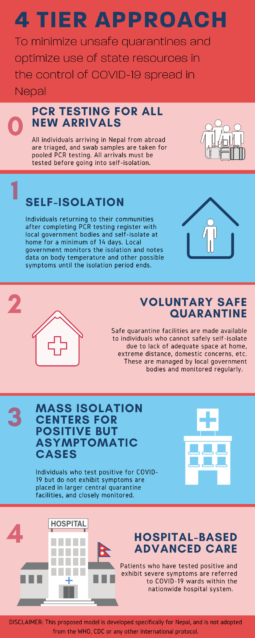
The virus is so contagious that cramming 15-20 people in one schoolroom, as Nepal was doing in these mass quarantine centers, would only increase infections. Science is very clear on this. That is why we believe that the government should take a more practical approach and promote a four-tier approach—firstly, allow those infected who can quarantine at home safely to do so. There are certain risks to families, but the risk of transmission is only limited to the size of the families. Secondly, since not all may have the means to self-quarantine at home, we may need to stay in an infection-safe mass quarantine. For example, a Nepali migrant worker who needs to travel further than Kathmandu, needs safe quarantine centers, preferably in Kathmandu, so they can go into voluntary quarantine. The first and second approaches should go parallelly. Then the third tier should be the isolation of those with confirmed cases without severe illness. There is no need to send those without any serious illness to the hospital and overwhelm hospitals. The government can prepare stadiums, halls and other big spaces and turn them into isolation centers. The fourth tier should be for those with severe illness due to the infection who need specialized treatment in hospitals and intensive care units.
Here’s a way to think about it—each health post covers on an average, depending on the density of population, about 1,000 households. Out of this, if we are to say a 100 households have one or more infected, the number is quite big, but not unmanageable. Home isolation does not require sophisticated clinical services. One needs to monitor fever, check for other signs and symptoms, and help suspected cases get tested. A sample collection and transportation can be arranged as road transport is possible in many parts. Once confirmed, the infected can be transported to isolation centers in ambulances. If health personnel cannot visit all those households, they can check via phones. It is important to note that communities are more responsive to local leaders, and that local authorities and health workers have greater powers of persuasion. I believe there will be more compliance to self-quarantine.
There is, however, a challenge of infection control during the transit as returnees may have to take public transportation where the risk of exposure is high. Poor access to testing due to insufficient polymerase chain reaction (PCR) test kits is also a big challenge. That said, the community is in a better position to deal with someone with symptoms who is at home in quarantine where local mechanisms can kick-in to help, than the one who stayed 15 days in quarantine and didn’t get diagnosed upon exit.
Not having enough test kits is a challenge, but that is also a global challenge. In Nepal, there are 50,000 PCR test kits as of today. New research is emerging about the validity of using a kit to test a pool if they don’t detect cases early enough. There is no point using rapid diagnostic tests (RDT) for diagnosis, there is a space for it in surveillance and contact tracing–but that is about it. We should either test with PCR, or we don’t test at all, there is no in-between. The PCR test kits currently imported from China are detecting more cases, so if they have to buy more from China and fly it every week, this is the time to do it.
What I see as a bigger challenge is in the commitment of our leaders and policymakers. We have excellent epidemiologists, public health experts, infectious diseases specialists. We have exceptional testing labs within the MoHP and academia. We should also leverage the capacity from the private sector. No one expects policymakers to be scientists. In these times of crises, what Nepal needs is a leader who understands the urgency and listens to science, makes bold decisions and acts. We cannot shift blame and deny because experience from other countries has proven that doing so will be extremely dangerous.
::::::::

Mallika Aryal Mallika Aryal is a Nepali freelance multimedia journalist, editor, and trainer based in Oslo. Mallika’s work focuses on social justice, inequality, health, media, human rights, identity, and inclusion.


Features
10 min read
Youths working their first jobs are often overworked, underpaid, sexually harassed, and mentally tormented by predatory employers in the name of opportunity and exposure.

COVID19
News
3 min read
The disruption in the tourism industry has hit hardest those working irregularly, like porters and guides.
Opinions
4 min read
We need to root out the culture of victim-blaming and slut-shaming in Nepal

COVID19
5 min read
Even as health experts push for more tests, govt has started scaling them down

COVID19
Features
7 min read
Women migrant workers fled abusive conditions to come home, but with no jobs and no savings, many of them are preparing to leave again.

Photo Essays
5 min read
Despite the Covid pandemic, last month, hundreds of pilgrims made the arduous journey through the treacherous mountainous terrain to Budinanda

COVID19
News
4 min read
A daily summary of Covid19 related developments that matter
