

Features
6 MIN READ

Whether or not students benefit, China's soft power is coming of age.

In June this year, The Himalayan Times reported with alarm that many private schools in Kathmandu had made Mandarin a mandatory subject, “lured by the Chinese government's offer to cover salaries of teachers who teach Mandarin.” The report claimed that mandatory Mandarin education in schools was illegal, and the news report was followed by an editorial titled “Abide by Law,” in which the newspaper urged private schools to get rid of mandatory Mandarin because it violated guidelines set by the Curriculum Development Centre. The Himalayan Times coverage was heavily circulated in Indian news outlets with headlines like “Compulsory Mandarin in Nepal's schools to make Himalayan state China ready for BRI”, “Mandarin now a compulsory language in Nepal’s schools as China foots the bill.”
A couple of months later, and following Chinese Foreign Minister Wang Yi’s September visit to Kathmandu, the Ministry of Education and the Chinese Embassy have signed a memorandum of understanding on the issue. China will expand its Volunteer Chinese Teachers Program, and Mandarin will be offered in more private as well as public schools across the country.
“Chinese is currently being taught in 80-85 community schools,” Ministry of Education spokesperson, Baikuntha Aryal told The Record. “This will expand slowly, and many more schools will teach Chinese.” Aryal refuted The Himalayan Times’s allegation that mandatory Chinese in private schools was against the law.
“All the Chinese volunteer teachers are vetted by the government. Of course we know about which private schools are offering classes,” Aryal said.
Bhanu Ahmad, vice principal of Gyanodaya Bal Batika School in Khokana, said the school has been offering Mandarin classes for eight or nine years. The classes are offered from primary school through to seventh grade, said Ahmad, explaining further that they are at a basic, introductory level, and not intensive.
Each year brings new teachers who are either university students or recent graduates from China who come through Kathmandu University’s Confucius Institute. The school doesn’t pay the teachers salaries, but is required to provide them with a small stipend and accommodation.
Mandarin has been offered at Rato Bangala School in Patan for a year. Jenny Manandhar, a coordinator at the school, said that the classes are mandatory for grades 1-5, and are also available for higher grades.
Gyanodaya, Rato Bangala, and many other private schools across Kathmandu including Pathshala School in Bagdol and Shuvatara School in Lamatar, do not test their students for Mandarin proficiency, and the language, although mandatory, is not a core part of their curriculum.
“Students have one Chinese period per week,” Ahmad of Gyanodaya school said. “It’s fun for them, the volunteers are mostly concerned with spreading a good message of Chinese art and culture and all that.”
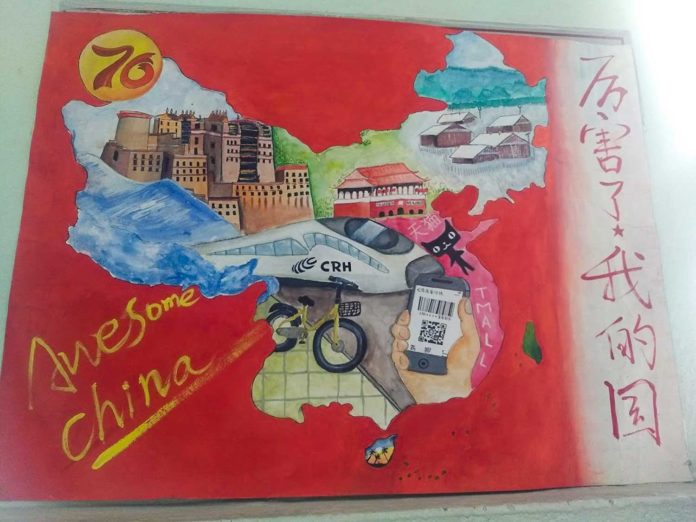
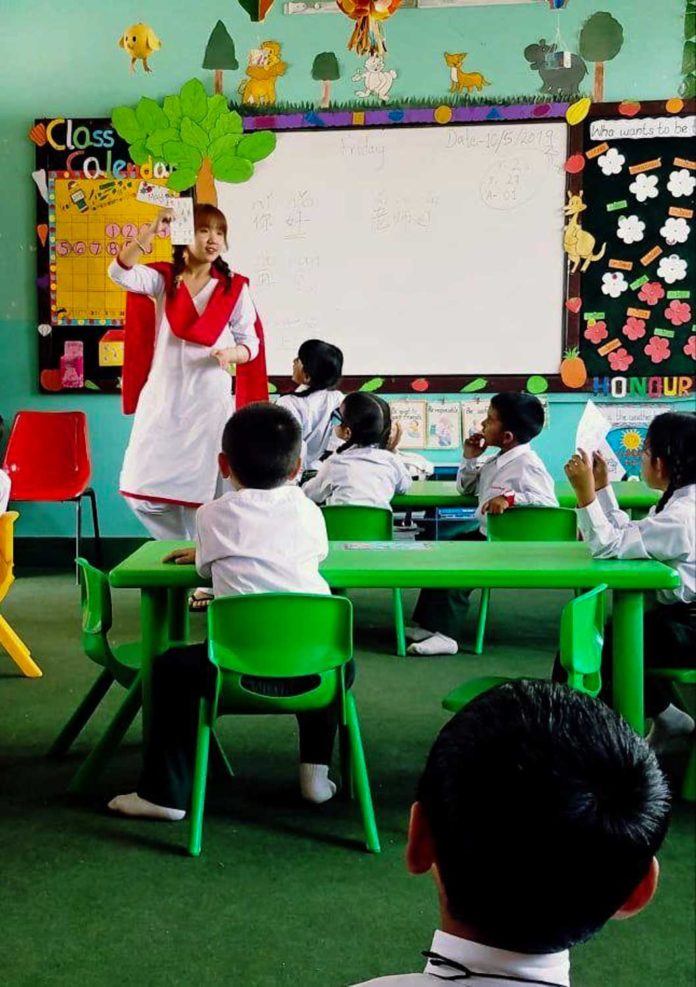
“Children love Chinese class because the teacher gives them stickers and organizes events,” Manandhar of Rato Bangala said. “She [the Chinese teacher] is organizing a Confucius Day event on September 18th, and will do things for various festivals.”
Mandarin classes in many private schools appear to be less about teaching the language, and more about familiarizing students with Chinese characters, songs, dances, and customs. Manan Das is in third grade at Pathshala school and has had Chinese classes since he was in Grade 1. When asked if he could speak some Mandarin, he said that he knew how to say “get up,” “good morning,” “sorry,” and a couple of other phrases, but that he wasn’t conversational yet.
“In Chinese class Jasmine ma’am teaches us panda passing games, we have acting, song, and dance competitions. It’s really fun!” Das said.
Fun for students, a demand from parents
Younger students enjoy Mandarin as a “fun” class that they don’t get tested on in school. (Aryal said that students can take a Youth Chinese Test, a proficiency test for children under 15, at the Chinese embassy if they want.) Parents, staff members at schools say, are very happy to have their children learn Chinese.
“The parents were elated that we are finally offering Chinese,” Manandhar at Rato Bangala School said. “We actually started offering it because of pressure from parents [since] Chinese is so strong and so trending worldwide.”
“I remember, Donald Trump’s daughter is learning Chinese as a second language. If America itself is giving so much importance to Chinese language, we, being China’s nearest neighbor and having such a diplomatic and congenial relationship with China, should definitely learn the language.” Ahmed at Gyanodaya said.
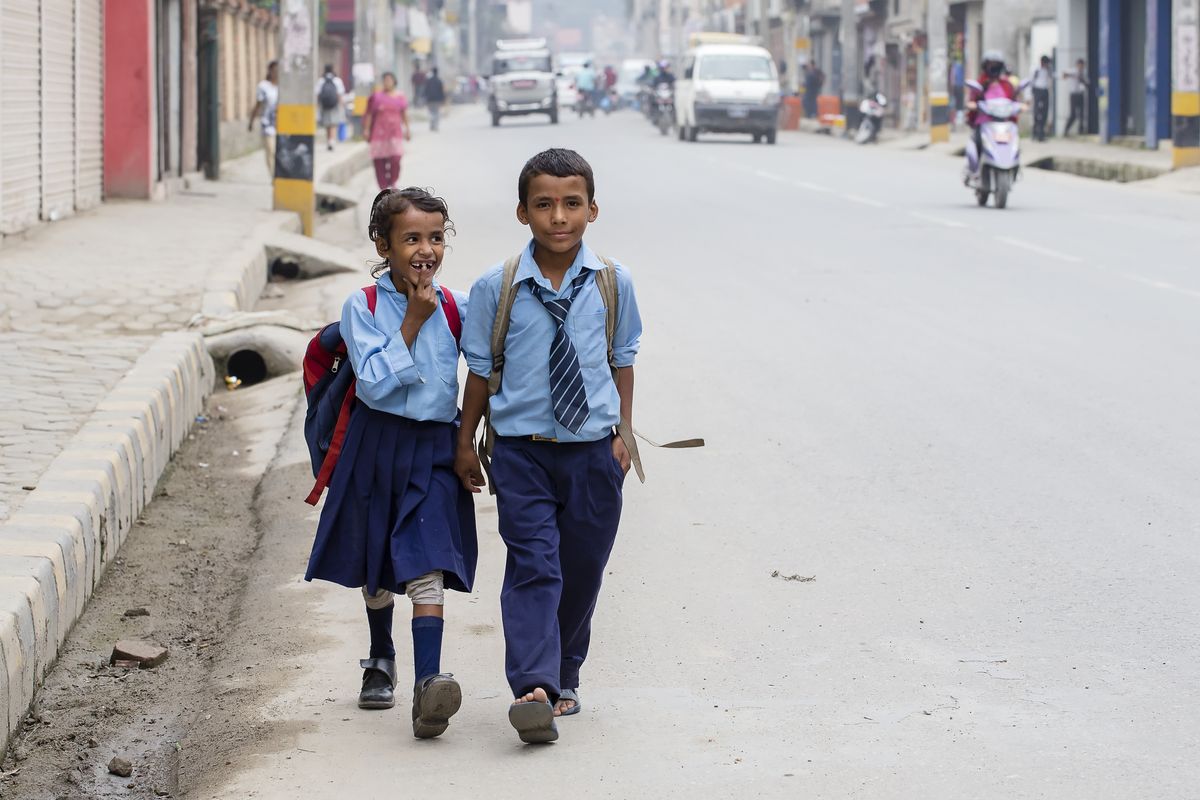
Many teachers and parents emphasise the fact that, given China’s growing importance as a potential market for business and place to find employment, learning Mandarin is an important marketable skill that could strengthen young people’s future prospects.
Shiv Raj Pant, founder of Learning Realm International (LRI) school in Kalanki, is a strong believer in the potential for Mandarin education to “change students’ lives.” LRI has had its own Chinese cultural institute – the only one in Nepal besides Kathmandu University’s Confucius Institute – for 13 years. Pant said that it had been inaugurated by the mayor of Beijing. Like the Confucius Institute, its instructors are predominantly volunteers from China.
“Do you know how many Chinese tourists are coming to Nepal every year?” Pant enthused. “The jobs that learning Mandarin will provide – there is endless potential.”
LRI is reputed for being the private school with the most intensive Chinese-language program in Nepal, and Pant believes that over time, the volunteer program will be phased out with more and more Nepalis being able to teach Mandarin. Pant believes that many private schools will start offering Mandarin in the near future. The principal of Galaxy school in Gyaneshwar agrees.
“We had Chinese about 16 years ago, before all these other places. The program was gradually phased out, but there is so much demand from parents that we are going to bring it back next year,” she said.
Opaque operations
The Confucius Institute, established in 2007 by Kathmandu University and China’s Hebei University of Trade and Business, is the organization through which most Chinese volunteer teachers find their placements. Kristina Maharjan, a staff member at the institute who liaises between schools and the volunteers, said that she could not share details about the number of private schools that are currently offering Mandarin and who the volunteer teachers are.
“We get applications from schools, then the institute goes and inspects the school to see whether it is a good fit or not. If it is, we send them teachers, and the schools have to give them a stipend and accommodation,” Maharjan said.
Pushpa Maharjan, the chief of the Kathmandu PABSON (Private and Boarding Schools Organization) said that he had no idea that many schools were offering Mandarin. “I know there is Korean in lots of schools, but do they also offer Mandarin?”
The Chinese embassy declined The Record’s requests for comment about the language programs. Two volunteer Chinese teachers at Gyanodaya school and six at LRI also declined to be interviewed, saying that they had been “instructed against speaking to any local media persons.”
Ruffling geopolitical feathers
The fact that the Chinese embassy and the institutions involved with Mandarin language programs have made so little information about it available appears to be a significant factor fueling the scepticism of many in Kathmandu of the program, and allowing fear-mongering interpretations, such as that of The Himalayan Times coverage, to gain traction.
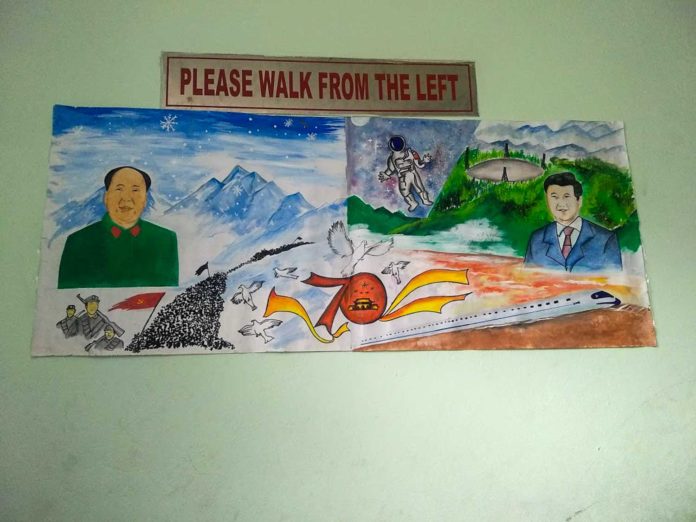
But Nepal is not the only – or even the first – country where Chinese language instruction at the primary level is growing rapidly and causing suspicion. Mandarin classes have increased rapidly in China’s African Belt and Road Initiative partners. Kenya has Mandarin language programs that are very similar to those offered in Nepal. In South Africa, Mandarin has been an optional language course for students since 2014, and in December 2018, Uganda introduced Mandarin to secondary students in selected schools.
There are over 480 Confucius Institutes around the world, established in partnership between national universities and universities in China. They have been critiqued for portraying a “selective” view of Chinese culture and politics. Much has been written of Mandarin expansion as a Chinese “soft-power” move. China is not unique, however, in its use of volunteers as a part of geopolitical objectives about “positive representations” of a country. Mandarin programs in Nepal and countries across Africa may be comparable to the American Peace Corps program which the Brookings Institute has said is “one of the least expensive instruments being used to advance U.S. foreign policy objectives.”
In the case of Nepal, these efforts have been marked by media, commentators, and analysts in India, with responses ranging from dismay about what the expansion of Chinese language education in Nepal says about India’s weakening influence, to more measured readings of Nepal’s geopolitical shift towards China.
With the Memorandum of Understanding between the Chinese and the Nepal government being signed, public schools will also start offering Mandarin, not just private schools. Whether this will translate into improved job or entrepreneurship prospects for Nepalis a generation from now remains to be seen, but the soft power goals, at least for now, appear to be bearing fruit.

Perspectives
5 min read
A letter from one of our readers reflects on the need for Nepal’s school children to learn at least two languages – one Nepali and the other freely chosen.

Features
Perspectives
8 min read
By introducing and enforcing the use of the English language from an early stage, we may be losing much more than we think.

COVID19
News
3 min read
A daily summary of Covid19 related developments that matter

Opinions
5 min read
Nepal needs a compulsory environmental curriculum to equip its future citizens to face an impending climate crisis

Week in Politics
5 min read
Week in politics: what happened, what does it mean, why does it matter?

COVID19
News
4 min read
A daily summary of Covid19-related developments that matter

Books
3 min read
The Gurkhas: A True Story by Tim I Gurung disrupts existing narratives on Gurkha history and experiences that have been penned mostly by western writers


