

Features
3 MIN READ

The school is committed to providing quality education for Muslims and non-Muslims alike
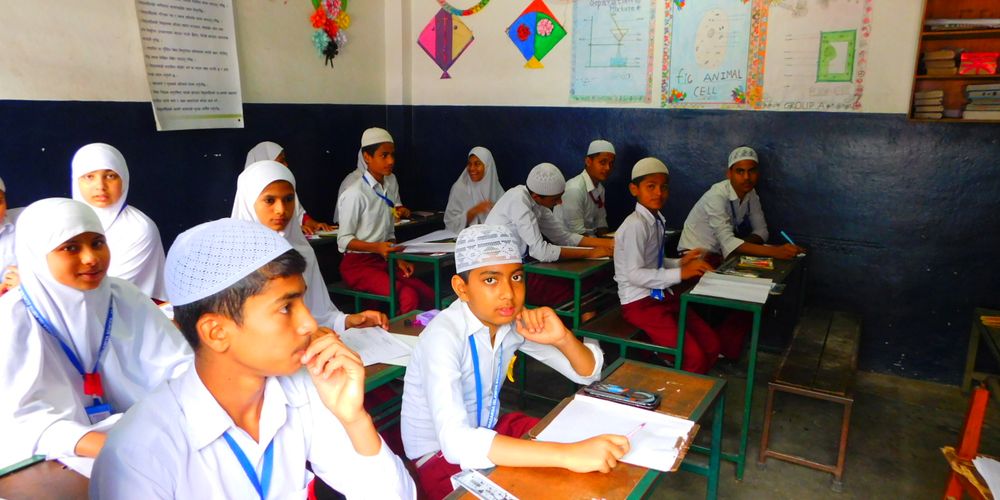
Madarasa Islamiya school in Kathmandu is popularly known for promoting the study of Quran and Islamic culture. But it is also serving as a prime model of how religious education can go hand in hand with secular values. Out of the 300 students enrolled in the school, 40 students are involved in dedicated study of the Quran while the rest of the student body follows the curriculum prescribed by the government of Nepal. The school runs up to eighth standard and welcomes students and faculty from Muslim as well as non-Muslim backgrounds. “Parents may think that we encourage students to convert to Islam. That is definitely not true,” said Feroz Khan, the principal of the school, “We don’t oblige non-Muslim students to take classes that are Islam focused, nor do we oblige them to follow our rituals.”
The conscious secularism practiced in the school is also reflected in the teaching faculty. Out of the 19 teachers employed by the school, almost half of them identify as Hindus and Christians. The school has a high faculty retention rate as many teachers express their desire to continue working for the school. The non-Muslim teachers are comfortable talking about their customs and beliefs with Muslim students who approach them with curiosity.
The level of comfort visible in the daily interactions between teachers and students was not always there. Non-Muslim teachers had a stereotypical perspective of the Muslim community. Many of them talked about their surprise at seeing that “ordinary” and “normal” life led by the community.
“When I first started working here, the Islamic greeting ‘Assalamu Alaikum’ was the only one allowed in the Madarasa,” said Aabeda Banu, the first female Muslim teacher in the school, “I have urged everyone to start using different greetings regardless of their language and religion.” Furthermore, Banu also redesigned the girls’ uniforms to make them more comfortable and adapted to the active student lifestyle.

Today, largely due to Banu’s efforts, female student enrollment at the school has increased. Half of the student population is female, and 12 of the 19 teachers are women. The presence of female faculty has made education and the joys of childhood more accessible to female students.
Unlike other private schools in Nepal, Madarsa Islamiya School remains affordable to students and parents with limited means. For a student living in the hostel, the annual charge is around 60,000 rupees or 600 USD. The school sustains itself with the revenue Jema Masjid receives from renting a business complex near the mosque. The low cost of the school has been a life-saver to many poor Muslim families, who want their children to receive modern education while remaining rooted in their culture and traditions.
Madarsa Islamiya School has attracted Muslim students from all over Nepal as well as some students from India. One of the students is Meraj Ansari, an eighth grader from Bihar who hopes to become a doctor someday. Ansari studies Science as well as the Quran, and can recite verses of Quran and the Nepali national anthem with equal zeal. During morning assembly, like students from most other schools in the country, the students at Madrasa Islamiya recite the Nepali national anthem.

Despite being committed to providing good, affordable education for students from various backgrounds, the school and the Muslim community affiliated with it have not been able to shed the historical biases that make them a target of suspicion and mistrust. Madrasa Islamiya School school is an exemplar of how tradition and modernity, religion and secularism can coexist. “Yet there seems to be a lot of misunderstanding and misconception when it comes to enrolling students in a Madarasa,” said Feroz Khan, the principal of the school.
:::
We welcome your comments. Please write to us at [email protected]


Perspectives
7 min read
A reflection on the hegemony of the language that is robbing us of fluency in our mother-tongues
Perspectives
5 min read
A letter from one of our readers reflects on the need for Nepal’s school children to learn at least two languages – one Nepali and the other freely chosen.

Features
11 min read
Covid-19 managed to break all geographical boundaries to reach the remote village of Lalu – and the couple who operate its only private school.

Features
6 min read
Whether or not students benefit, China's soft power is coming of age.

Interviews
11 min read
A 1963 interview with writer and critic Krishna Chandra Singh Pradhan

Features
6 min read
This year marks 120 years since eight Nepali students first went to Japan for their higher education. Now, that number has swelled to the thousands.

Writing journeys
6 min read
Introducing ‘Writing journeys’, a new series curated and edited by Tom Robertson where Nepali writers reflect on their non-fiction writing.

Week in Politics
5 min read
Week in politics: what happened, what does it mean, why does it matter?

