
News Analysis
3 MIN READ


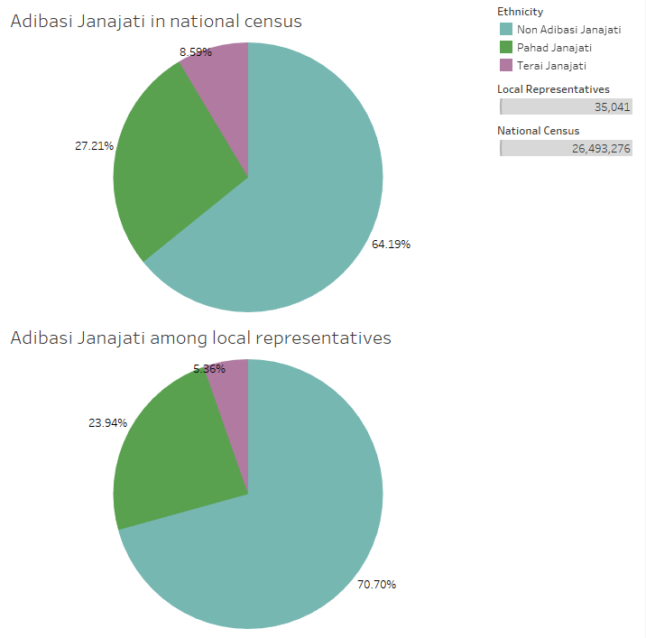
The Adibasi Janajatis, who are the indigenous people of Nepal, make up 35.8% of Nepal’s population. Major indigenous groups include hill-indigenous (Sherpa, Tamang, Magar, Gurung, Rai, Limbu and others), and Terai-indigenous (such as Tharu, Santhal, Rajbanshi, Dhami and others). The total number of indigenous groups in Nepal, according to government statistics, is 63, where 50 are hill-indigenous and 13 are Terai-indigenous.
In the 2017 local elections, the Adibasi Janajatis won 29.3% of the seats, 6.5 % below their share of the population. Overall, hill Adibasi Janajatis, which are 27.21% of population, won 23.9% of seats, while Terai-Janajatis, which are 8.6% of population, won 5.4% of local posts.
Urban-rural divide in Adibasi Janajati representation
The mayor and deputy mayor posts are for urban municipalities, while the chairperson and deputy chair posts are for rural municipalities. Adibasi Janajatis were underrepresented in the mayoral post, having won only 25% of seats. However, they had more proportionate representation in the chairperson posts, with 36% of the seats.
Within Adibasi Janajatis themselves, hill-Janajatis won 17.4% of the mayoral seats. In rural municipalities, they are overrepresented with 32% of the chairperson posts. However, this urban-rural correlation does not apply to all groups within the hill-Janajatis. Newa, who are considered comparatively more privileged hill-indigenous, are proportionally represented (5%) in the mayor and deputy mayor posts. The Terai-Janajati, with 4% each of the chair and deputy chair post, are represented only half as much as their national share of population in the the rural municipality posts.
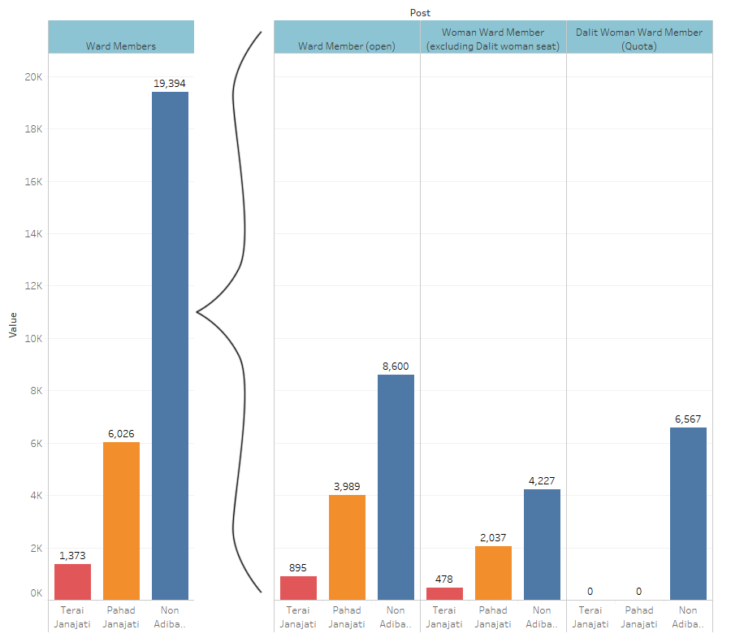
In the ward chair position, Terai-Janajati won 6.11% of the posts. Out of the 26,793 ward member seats, both hill and Terai indigenous are underrepresented (22.5% and 5.1% each). When we set aside the Dalit woman ward member seat and look at the remaining woman ward member and open competition ward member seats separately, we see that Terai-Janajati representation dips further.
Maoists have greatest proportion of Adibasi Janajati local representatives
Of all the total local candidates per party, 33.4% of Maoists local representatives are Adibasi Janajati, while Sanghiya Samajbadi Forum has the lowest share, at 6.6%.
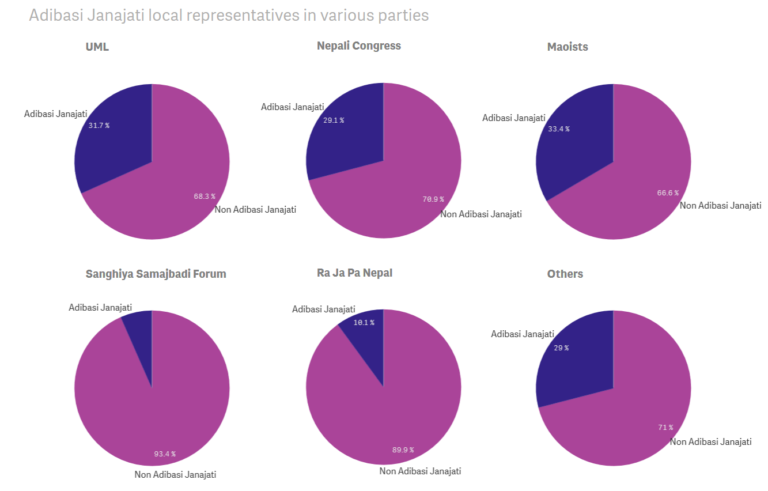
Sanghiya Samajbadi Forum and Ra Ja Pa, despite being parties advocating for issues of identity and inclusion, have negligible presence of hill Adibasi Janajati among their local representatives. Their origin as Madhes based regional parties and late transition to national level politics could be the possible reasons for this.
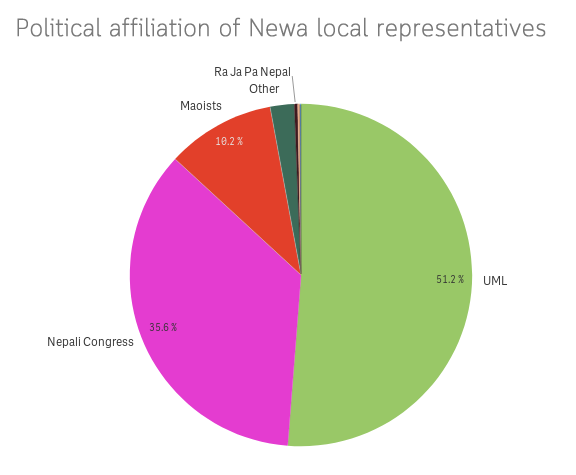
The relationship between party affiliation of local representatives and party representation of ethnicity reveals a complex picture. Most Newa representatives belong to UML and Nepali congress. However, Newa are not proportionally represented by either party: they account for 5% of the population of Nepal, but make up only 3.5% and 3% of local representatives from UML and Nepali Congress. In fact, they are not proportionally represented by any party.
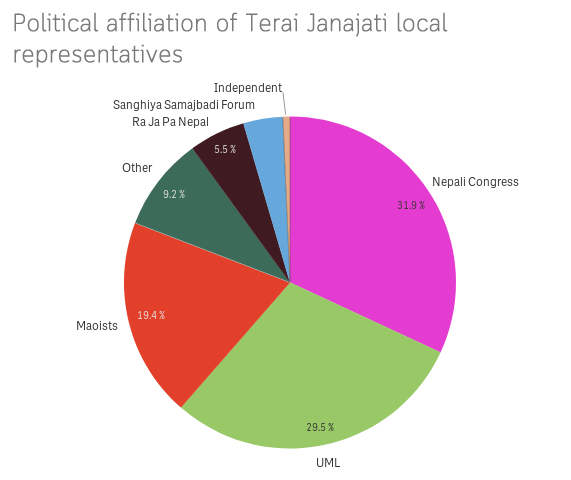
In the case of Terai-Janajati, they have their highest representation in-party in Ra Ja Pa Nepal (9.3%), but of all the Terai-Janajati local representatives, the greatest number are in Nepali Congress and UML, and again, neither party has proportional representation (3.9% and 5.9% each, as compared to the national share of 8.6%).
Analysis of Adibasi Janajati local representatives shows many points of intersectionality. Terai-Janajati are in general more excluded than hill-indigenous, but hill-indigenous are more excluded in urban municipalities, and among hill-indigenous, Newa have good representation in urban centers, but are underrepresented in all parties. While Terai-Janajati local representatives are mostly in the major parties, Ra Ja Pa has the highest proportion of Terai-Janajati local representatives.
All charts by Supriya Manandhar


The Wire
News
7 min read
Seventeen years after emancipation, many ex-kamaiyas prepare to vote in local elections for the first time

Features
5 min read
Determined to crush Maoist rebels instead of seeking a political solution, Oli is repeating the same mistakes Deuba made in the 90s which resulted in a decade-long people’s war
Features
9 min read
What to expect with regards to local politics, American aid, immigration to the US, and the battle against climate change
Explainers
9 min read
Here’s a handy list of things to keep in mind, especially for first-time voters, while voting in the 2022 local election on Friday, May 13.

Features
5 min read
The ruling party’s top leaders have finally come to a truce, but the peace probably won’t last

News
3 min read
The Supreme Court steps in to put a stop to the NCP’s latest attempt to hoist also-rans to positions of power

News
3 min read
The number of Dalit candidates for top jobs in municipal and village councils is near zero despite commitments for inclusion in the constitution and party documents.

Perspectives
6 min read
Federalism appears to be working in exactly the two places—with distinct regional identities—where it was most likely to work.