

Opinions
Perspectives
3 MIN READ

Parallels with another Great Earthquake in 1934
![These are perplexing times for those who work in the big agencies which for decades have pumped money into Nepal for prevention and response to an earthquake that has long been announced. But all the high quality and expensive programs have shown little fruit in the days since the April 25 quake, a period characterized by a dawdling government, unable to prioritize and take clear decisions.
It has also been a period of great improvisation—some five days after the quake, Minister of Information and Communications Minendra Rijal announced a proposal on the hoof to set up an All Party Mechanism to monitor the response, while Prime Minister Sushil Koirala announced that he had ordered the drawing up of a list of essential materials which would then be the exclusive list of items foreign agencies could bring in. There must be such a list in government hands if anyone knew where to look for it, and in any case the UN Office for the Coordination of Humanitarian Affairs and the main response agencies have enough experience to calculate the priorities in such a situation.
On day ten of the quake, the prime minister disconcertingly announced that, “Our country is technically not well equipped in disaster management, then also I request every official to leave no stone unturned as per our capacity.”
So where did it all go wrong? How come so many inputs led to so few outputs? It's not as though anyone could claim not to have been adequately warned.
The Great Earthquake in Nepal 1934 AD, published the year of the quake by Major General Brahma Shumsher Jung Bahadur Rana, describes the response to the previous earthquake in terms that apply to this latest disaster:
“WHAT REMAINED INTACT IN MANY YEARS OF WARS WAS DESTROYED IN AN EARTHQUAKE. . . . IN NEPAL, 8,519 DEATHS WERE REPORTED . . . THE CRISIS ITSELF COULD BECOME A FORTUNATE OPPORTUNITY. . . . WITH THE EARTHQUAKE COMING AT THAT JUNCTURE THE OFFICERS AND OTHERS IN THE CAPITAL WERE OVERWHELMED BY THE EVENT. . . . THERE WAS A MOVEMENT IN THE LAND SIMILAR TO THAT OF WAVES IN THE WATER. . . . EVERYBODY BEGAN TO RUN TOWARDS OPEN SPACES . . . IN KATHMANDU THEY CAME TO TUNDIKHEL . . . IT WAS ONLY VERY SLOWLY THAT REPORTS FROM THE HILLS WERE RECEIVED. . . . MERCHANTS SHOULD NOT SEEK GREATER PROFIT AT SUCH A TIME. THEY HAVE TO SELL AT THE USUAL PRICE AND FOOD GRAINS SHOULD NOT BE HIDDEN. OTHERWISE THE MERCHANTS WOULD BE
PUNISHED . . .”
There are even precise warnings that should have guided planning for this latest event, for example: “All sorts of rumours began to circulate, forecasting events for the next few days and the people who had been in a state of panic began to believe them.” And, “[i]t was only after 15 or 16 days later that it was possible to arrange for sale of food grains in rural areas. Not to speak of the hills, it was quite difficult to take the food grains by lorries due to the damaged roads.”
The good general’s book is almost the beginning of a manual that could have been used to prepare for this quake, though there are one or two idiosyncratic insights into 1930s Rana-era Nepal that might need some updating: “According to astrological calculation, a catastrophic event has been forecast long ago due to the configuration of seven planets—the Sun, Moon, Mars, Mercury, Saturn, Rahu (another name for the moon’s ascending mode) and Venus . . . at 4 o’clock on Monday the 15th of January.” And, “ ‘martial law’ was enforced for public security. . . . The killing of a thief will not be a crime. . . . Extraordinary measures were required at critical times.”
But Brahma Shumsher even pointed to the key lesson that is being relearned as this crisis unfolds: “The volunteers also rendered much service. They raised funds and collected food grains and distributed the same among the poor.”
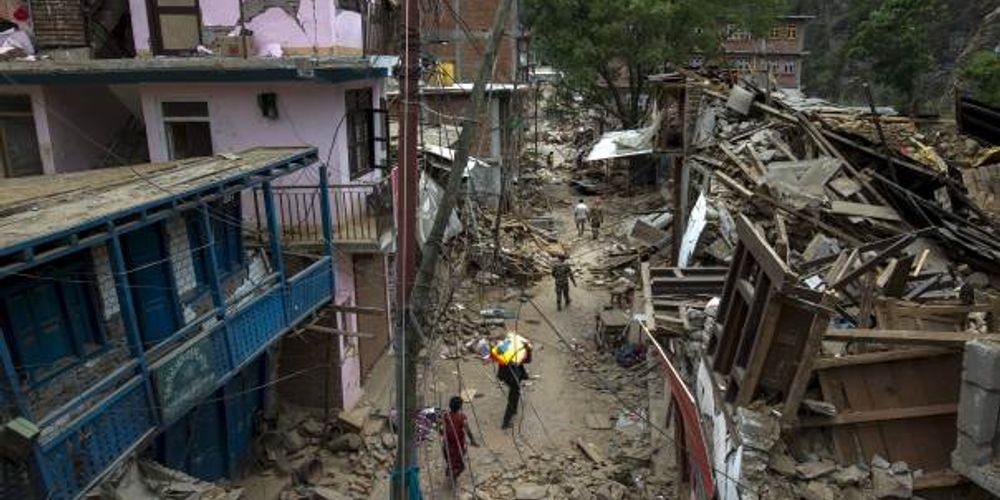
Cover photo: A family salvages their belongings from the ruins of their home in Harre Dada, Sindhupalchowk. Pete Pattisson](https://assets.rumsan.net/clients/recordnepal/1617878151266)
These are perplexing times for those who work in the big agencies which for decades have pumped money into Nepal for prevention and response to an earthquake that has long been announced. But all the high quality and expensive programs have shown little fruit in the days since the April 25 quake, a period characterized by a dawdling government, unable to prioritize and take clear decisions.
It has also been a period of great improvisation—some five days after the quake, Minister of Information and Communications Minendra Rijal announced a proposal on the hoof to set up an All Party Mechanism to monitor the response, while Prime Minister Sushil Koirala announced that he had ordered the drawing up of a list of essential materials which would then be the exclusive list of items foreign agencies could bring in. There must be such a list in government hands if anyone knew where to look for it, and in any case the UN Office for the Coordination of Humanitarian Affairs and the main response agencies have enough experience to calculate the priorities in such a situation.
On day ten of the quake, the prime minister disconcertingly announced that, “Our country is technically not well equipped in disaster management, then also I request every official to leave no stone unturned as per our capacity.”
So where did it all go wrong? How come so many inputs led to so few outputs? It's not as though anyone could claim not to have been adequately warned.
The Great Earthquake in Nepal 1934 AD, published the year of the quake by Major General Brahma Shumsher Jung Bahadur Rana, describes the response to the previous earthquake in terms that apply to this latest disaster:
“What remained intact in many years of wars was destroyed in an earthquake. . . . In Nepal, 8,519 deaths were reported . . . the crisis itself could become a fortunate opportunity. . . . With the earthquake coming at that juncture the officers and others in the capital were overwhelmed by the event. . . . There was a movement in the land similar to that of waves in the water. . . . Everybody began to run towards open spaces . . . in Kathmandu they came to Tundikhel . . . It was only very slowly that reports from the hills were received. . . . Merchants should not seek greater profit at such a time. They have to sell at the usual price and food grains should not be hidden. Otherwise the merchants would be
punished . . .”
There are even precise warnings that should have guided planning for this latest event, for example: “All sorts of rumours began to circulate, forecasting events for the next few days and the people who had been in a state of panic began to believe them.” And, “[i]t was only after 15 or 16 days later that it was possible to arrange for sale of food grains in rural areas. Not to speak of the hills, it was quite difficult to take the food grains by lorries due to the damaged roads.”
The good general’s book is almost the beginning of a manual that could have been used to prepare for this quake, though there are one or two idiosyncratic insights into 1930s Rana-era Nepal that might need some updating: “According to astrological calculation, a catastrophic event has been forecast long ago due to the configuration of seven planets—the Sun, Moon, Mars, Mercury, Saturn, Rahu (another name for the moon’s ascending mode) and Venus . . . at 4 o’clock on Monday the 15th of January.” And, “ ‘martial law’ was enforced for public security. . . . The killing of a thief will not be a crime. . . . Extraordinary measures were required at critical times.”
But Brahma Shumsher even pointed to the key lesson that is being relearned as this crisis unfolds: “The volunteers also rendered much service. They raised funds and collected food grains and distributed the same among the poor.”
Cover photo: A family salvages their belongings from the ruins of their home in Harre Dada, Sindhupalchowk. Pete Pattisson

John Rhys Bevan John Bevan is a former UN official who worked in Haiti before and after the 2010 earthquake. He worked in Nepal in 2003-4 and 2006-7.


Opinions
Perspectives
10 min read
There are many things the government can do to improve relief efforts, but issuing directives on aid activities is not one of them

Opinions
Perspectives
3 min read
Parallels with another Great Earthquake in 1934

Features
The Wire
8 min read
Laprak was heavily damaged during the earthquake; its fate now hangs in the balance

The Wire
6 min read
Survivors resort to their own funds to rebuild
COVID19
Opinions
9 min read
Unless Nepal comprehensively overhauls its disaster response mechanisms, we’ll continue to see the nation reeling with every crisis

Perspectives
Opinions
4 min read
On April 24, 2016, exactly a year after the 2015 earthquake, Prime Minister K.P. Shama Oli launched the reconstruction campaign by laying the foundation stone for the house of Sarita Tamang in Chautara, Sindhupalchok. Sarita Tamang talks about the media spectacle that surrounded Oli laying the foundation stone, and the subsequent absence of government support during the actual construction work

Opinions
Perspectives
3 min read
The coming monsoon brings with it a high risk of food shortages in earthquake affected districts
The Wire
Features
5 min read
Victims of the 2015 earthquake in Dolakha have rebuilt their homes in areas where they could be decimated any day