

Explainers
3 MIN READ

Millions cannot get citizenship certificates, as political parties fail to pass the Citizenship Bill.

The Citizenship Bill, tabled in the House of Representatives a year ago, remains stuck there, as political parties remain divided on provisions in the bill.
In the new constitution, some provisions on citizenship require a federal law, and there are some provisions that contradict those of the Citizenship Act 2006. Without a revised law governing the regulation of citizenship, it is not clear who has jurisdiction and how people applying for papers -- either through birth or naturalisation -- are to be treated.
This year alone, hundreds of people have tried -- and failed -- to get their citizenship papers. The few who can, have taken their cases to the Supreme Court. But in the apex court, there is a confusion that would be comical, if it did not have such terrible effects on people’s lives.
This is what has happened in the last five months:
At stake is not just clarity from the Supreme Court in this critical constitutional matter, but the question of how the state treats people. A December 2015 study by the Forum for Women, Law and Development (FLWD) estimated that 5.4 million people in Nepal do not have citizenship certificates -- almost a quarter of the country’s population aged 16 and above. FWLD projects that the estimate (5.4 million), might reach 6.7 million by 2021, which would equal 26.14 percent of the total population.
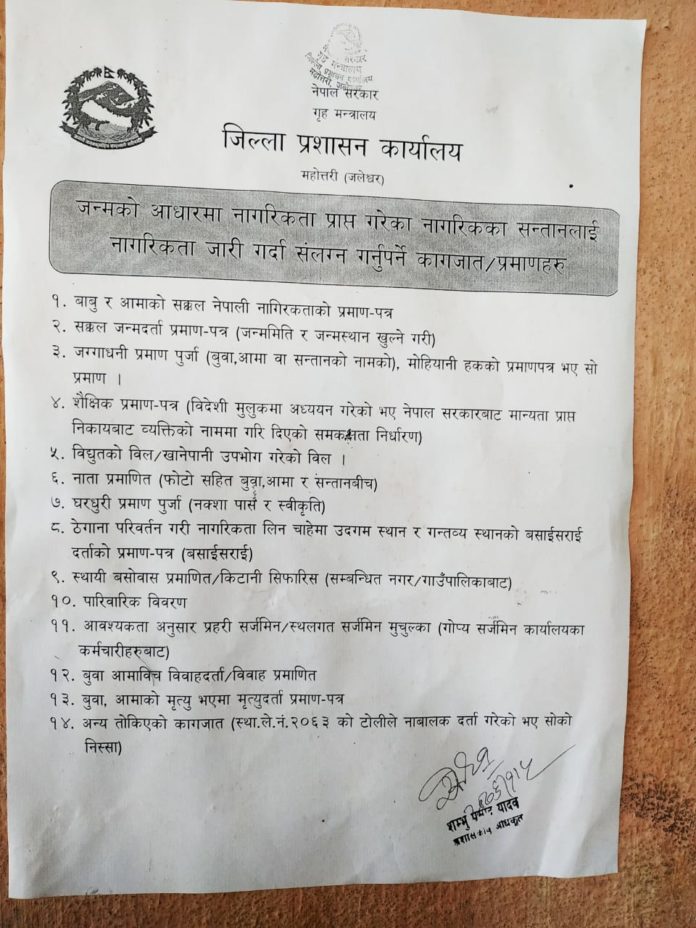
What everyone without papers has in common is that they are unable to vote, register marriages or births, buy or sell land, appear for technical or professional exams, open bank accounts, gain access to credit, and receive state social benefits. They are denied access to their fundamental rights and to essential state services. The strain this places on individuals and families can be unbearable. The Tarai Human Rights Defenders Alliance has recorded at least one case of suicide that it believes resulted from the distress of being repeatedly refused citizenship papers.
Even when people are able to invest the time and effort and resources to go to the Supreme Court and win, this means little. Arjun Sah of Mahottari successfully sued the government to be eligible for naturalised citizenship. He filed his case against the government in the apex court on February 18, 2013 and the final verdict was delivered on August 21, 2018.
“Three months ago, I submitted the required papers to the Home Ministry following the verdict,” he said. “An official informed me that a meeting will be held to issue the certificate.”
It seems the ministry still is dragging its feet on issuing his papers. “Your citizenship certificate will be issued soon after the enactment of the law,” he added quoting the official.
:::
We welcome your comments. Please write to us at [email protected]

Praveen Kumar Yadav Praveen Kumar Yadav writes on the contemporary issues of development, politics, human rights and social justice. He tweets at @iprav33n


Perspectives
6 min read
The fundamental idea of a masculine Pahadi ethno-state needs to be challenged

Features
COVID19
5 min read
After suffering injustice for years, the farmers have finally descended on Kathmandu to press their demands

Features
8 min read
Politicians have mastered the art of exploiting the nexus between themselves and prosecutors to always remain beyond the arm of the law

Features
4 min read
A new amendment to the CIAA bill focuses on the business community but spares state bodies
COVID19
Features
6 min read
The govt has finally heeded expert suggestions to create a hospital dedicated only to treating coronavirus cases
Explainers
9 min read
By proposing a party general convention in December, Oli has managed to turn the tables on his comrades who want to oust him, but given the NCP’s overall landscape, the current stalemate at the top will likely continue

Explainers
6 min read
The sexual violence allegation against Mahara is a test for the government, CPN and state institutions.

COVID19
Features
3 min read
A new set of rules enforced on the eve of the reopening appear designed to ensure Covid’s rapid spread rather than containment