

Features
3 MIN READ

Lack of pigmentation makes the turtle appear golden in colour
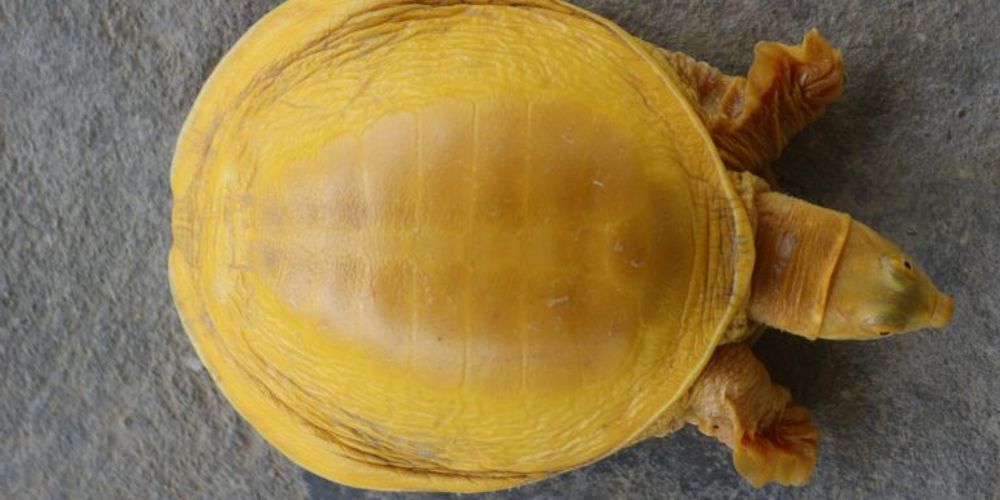
After news of the existence of a yellow turtle in India's eastern state of Odisha went viral this past July, Nepalis wanted to remind the world that they made a similar discovery first — on April 14, 2018, to be exact — when a rare, golden turtle — but a different species — was found for the first time in southeastern Nepal’s Dhanushadham municipality.
According to a research paper by Kamal Devkota, Dev Narayan Mandal and Hinrich Kaiser, which was published in the journal Herpetology Notes, the turtle was released into its natural habitat after pictures were taken as proof.
In an email interview with Global Voices, Devkota explained:
Our team member, Chandradeep Sada, rescued this rare golden turtle from Dhanushadham Municipality, Nepal on April 14, 2018. Later, Dev Narayan Mandal identified it as an Indian flapshell turtle [scientific name Lissemys punctata]. We further researched it and found that the colour aberrations are quite rare in nature. The lack of body pigmentation made the turtle appear golden coloured, with only the eyes showing a dark pigmentation.
This is the first chromatic leucism in L. punctata in Nepal, which is the first for the northern subspecies of L. punctata and the fifth documented observation in the species. That's why it is very important for conservationists and researchers.

A normal Indian flapshell turtle is greenish-grey in colour, with yellow marks on its head and neck. It has a grey carapace dotted with dark yellow spots and derives its name from the femoral flaps at the plastron, the ventral part of the shell.
These turtles are found in Bangladesh, India, Myanmar, Nepal, Pakistan and Sri Lanka, most typically in ditches, lakes, ponds and paddy fields with stagnant water. Omnivorous in nature, they eat anything from leaves and flowers to snails, fish and frogs.

While a normal-coloured flapshell turtle can easily camouflage itself in the murky, greenish water, its golden-coloured variant — a turtle with chromatic leucism — is easily recognisable and therefore more vulnerable. Its luminous golden colour, in particular, makes it a prized pet.
The congenital disorder of albinism creates a complete absence of pigmentation in the skin, hair and eyes due to the lack of tyrosinase, an enzyme involved in the production of melanin. Researchers estimate that albinism occurs once in every 10,000 mammal births.
Leucism, on the other hand, is an extremely rare genetic condition in which animals have reduced pigmentation. Most leucistic animals have normal-coloured eyes, whereas those with albinism tend to have red or pink eyes.
Nepal is home to 16 species of turtles, of which four are critically endangered: the three-striped roofed turtle (Kachuga dhongoka), the red-crowned roofed turtle (Kachuga kachuga), the Indian narrow-headed softshell turtle (Chitra indica) and the elongated tortoise (Indotestudo elongate).
Though turtles play an important role in reducing pollution by feeding on insects, vegetation and dead animals, factors like habitat loss, fragmentation and degradation have been threatening their survival.
According to “Turtles of Nepal – A Field Guide for Species Accounts and Distribution,” the draining of wetlands for irrigation and fishing, the excessive use of agrochemicals which eventually seep into waterways and unsustainable fishing methods all negatively impact turtle populations.
Adding to their woes is the illegal trade for keeping turtles as pets, as well as their use in traditional medicine. Some people believe in eating turtles and their eggs to achieve improved health, longevity and virility. Turtle shells are also used to make curio items.
Despite such threats to Nepal’s turtles, conservationists and other local bodies, such as the Turtle Rescue and Conservation Center in eastern Nepal, have been working to save these magnificent creatures.
This article was previously published in Global Voices, an international and multilingual community of writers, translators, academics, and human rights activists.
::::::


Features
8 min read
The deportation of Nepali migrant workers from Qatar is just one example of the unfair treatment they have experienced abroad

Features
11 min read
The journey of a Nepali migrant who crossed 15 borders to reach the US

Perspectives
12 min read
Covid-19 has highlighted the potential benefits of small-scale family farming
Features
4 min read
Public support for Dr KC’s cause has forced the government’s hand, but as always, questions remain about the agreement’s implementation

News
3 min read
Police respond to protests with water cannons and arrests

COVID19
Features
5 min read
Recruitment of volunteers to enforce the lockdown has had mixed results
Photo Essays
4 min read
These women spend all day carrying and transporting bricks. They represent the changing face of the construction industry in Nepal.


